Posts

Image
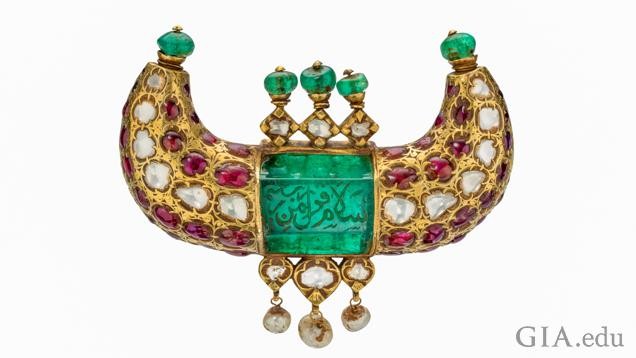
Introduction Large flawless diamonds from the Golconda region. Rich green emeralds from Colombia. Blood-red rubies from Burma. Only the most visually striking would do, set in the purest gold. For more than 5,000 years, jewelry has played an integral role in the history of India. Wars were fought and empires won and lost in pursuit of these riches. Yet, because of cultural practices, relatively little of the historic jewelry exists, the gems and precious metals repurposed by succeeding generations. The jewels in “Centuries of Opulance: Jewels of India,” which will be on display in Carlsbad until March 2018, are on loan from a private collection and showcase more than 300 years of adornment in India from the 17th to the 20th century, including several from the magnificent Mughal Era (1526–1857).   JOURNEY OF THE GEM Some of our most celebrated diamonds—including the infamous Hope and Koh-i-Noor—originated from India’s famed Golconda mining area. The Indian ari...

FACTS ABOUT GOLD

Gold is the only metal that is yellow or "golden". Other metals may develop a yellowish color, but only after they have oxidized or reacted with other chemicals. Nearly all of the gold on Earth came from meteorites that bombarded the planet over 200 million years after it formed. The element symbol for gold is Au. The symbol comes from the old Latin name for gold,  aurum , which means "shining dawn" or "glow of sunrise". The word "gold" comes from the Germanic languages, originating from the Proto-Germanic  gulþ  and Proto-Indo-European  ghel , meaning "yellow/green". The pure element has been known since ancient times. Gold is extremely ductile. A single ounce of gold (about 28 grams) can be stretched into a gold thread 5 miles (8 kilometers) long. Gold threads can even be used as embroidery thread. Malleability is a measure of how easily a material can be hammered into thin sheets. Gold is the most malleable element. A single o...

Dyed Yellow Beaded Freshwater Cultured Pearls Imitating South Sea Cultured Pearls

Image
In the spring of 2017, the Gübelin Gem Lab received a yellow pearl necklace for testing. The size and color of the specimens implied that they were South Sea cultured pearls. The high insurance value appeared to confirm this; however, there were some suspicious color patches that suggested the material had been dyed. Only a few months earlier, author LK visited the Hong Kong office of Grace Pearls, a large producer with a pearl farm and factory in China, to see their latest batch of freshwater cultured pearls. Grace Pearls developed a proprietary method to grow large freshwater pearls with bead, marketed as “Edison” pearls. These occur in all the known colors of traditional freshwater pearls, typically white, orange, pink, and purple. To  complement their color range, they also offer yellow and black treated pearls ranging from approximately 12 to 18 mm. The goods we saw at Grace Pearls had a wide range of qualities and prices. The lowest price for a strand of Edison pe...

What are Gemstones

What are Gemstones? Gemstones are basically rocks or minerals that are cut and polished to enhance their natural beauty. They are of various colors and shapes. Human kind has always been fascinated by gemstones and their beauty. Today, gemstones are used for astronomical as well as ornamental purposes. The beautiful cut, shine, and shapes attract a lot of people from all over the world. Why should you wear gemstones? There are many reasons why you should wear gemstones. Traditionally, they are believed to remove all the negative energies attached to any zodiac sign. There are different gemstones for all zodiac signs, so you can benefit a lot by wearing a gemstone of your zodiac sign. Opal, yellow sapphire, emerald,  ruby , red coral etc are the names of a few gemstones which are said to possess great powers. It is said that they transfer energies to people by body contact and cures many diseases. It is also said that they are bring good luck with them. So if you are havi...

HPHT Synthetic Diamond

Image
HPHT Synthetic Diamond Melee Without Si or Ni Defects Figure 1. These four near-colorless round brilliant melee were identified as HPHT synthetic diamonds lacking the typical Si- and Ni-related defects.  Near-colorless synthetic diamond melee grown using the high-pressure, high-temperature (HPHT) method have created significant concern in the industry, and various screening methods have been developed to take into account their most reliable distinguishing features. In general, the specimens described in previous Lab Notes (e.g. Summer 2015, pp. 183–184) were very small round faceted goods ranging between 0.005 and 0.01 ct. Recently GIA’s Bangkok laboratory received four loose near-colorless round brilliants for quality assurance service (figure 1). They weighed between 0.07 and 0.09 ct, slightly more than previously submitted melee. All were identified as type IIb HPHT-grown material using Fourier-transform infrared (FTIR) spectroscopy. Their most interesting featur...

The right way of buying gemstones

The treatment of gemstones is a complex science which has evolved over hundreds of years. The discovery of gems dates back to pre historic period and there are references in Indian Puranas and mythology about various precious Gems those were being amassed and formed part of the treasury of the Emperors. The award for any exemplary achievement either in warfare or in fine arts were rewarded by gifts of precious stones Gems have become affordable and formed the property of common man later, and Gem studded Jewellery is now part of the wardrobe of any modern woman. From time immemorial besides the use of gems for the ornamental purpose its hidden qualities to substitute vital elements of Human body was known. Though believed as the   Magical   properties of these stones they were being used for various ends from reaping riches to remedying the maladies. However it was not until the development of the modern science and chemistry the chemical properties of these natural st...

Treatment

Treatment WHAT does TREATMENT IN GEMSTONES mean? Treatment on gemstones refers to any human process (other than cutting and polishing) which improves the appearance (colour and clarity) or durability of a gem. Gems are treated in different ways like heating, surface diffusion, glass filling, beryllium diffusion, irradiation, fracture filling etc to alter their appearance. According to a survey done by GIA in 2005 95% ruby and sapphires (blue and yellow) available in the market were treated by heat. In our experience more than 99% rubies and sapphires (blue and yellow) available today are treated in some way or the other. Untreated gemstones are rarest of the rare gemstones as every piece is a unique creation of mother earth formed in thousands of year. Each gem is distinctive and irreplaceable. In fact it is a matter of fortune to find an untreated gemstone of your choice when you want to own one . Identifying whether a gemstone is treated or not needs good gemmological k...